

A CLEARER PATH FOR AMERICAN HEALTHCARE
Healthcare
as Infrastructure
A practical, nonpartisan framework for a more reliable, accountable, and sustainable healthcare system.
The idea behind the work
What does it mean to treat healthcare as infrastructure?
Think about the things you rely on every day without a second thought. You turn on the tap and clean water comes out. You flip a switch and the lights come on. You drive across a bridge and trust that it will hold.
Many of those systems are run by private companies. Utilities earn profits. Airlines compete for customers. Banks are businesses. Yet none of them operate like an ordinary store. Because society depends on them, they operate inside public guardrails: safety standards, transparency rules, and accountability when things go wrong.
That is what infrastructure means. It is not about who owns something. It is about what that thing does for all of us.
Healthcare already does that work. When it fails, families go bankrupt, workers can't work, and communities lose their hospitals. Yet in the United States we largely govern healthcare like routine market commerce, as if a cancer treatment were the same kind of purchase as a television.
Healthcare as Infrastructure asks a simple question: what if we governed healthcare according to the role it actually plays in our lives?
Healthcare is infrastructure. Governance is the architecture that allows that infrastructure to fulfill its purpose.
The Governance Framework
It starts with one question: what kind of system is healthcare?
Before we argue about who pays or which plan is best, we have to answer a more basic question. Is healthcare ordinary commerce, or is it infrastructure? The answer sets off a chain reaction.
The classification chain: five steps
Classification
What kind of system is it: ordinary commerce or infrastructure?
Governance
Classification decides which rules apply and who is accountable.
Incentives
The rules decide what gets rewarded: care or margin.
Behavior
People and organizations respond to what is rewarded.
Outcomes
Cost, access, and health results follow from that behavior.
Healthcare as Infrastructure starts here: change the classification, and the entire chain can change.
When healthcare is classified as ordinary commerce, the system rewards margin. Denials, surprise bills, and runaway prices follow. They aren't caused by bad people. They are the predictable result of the rules. Change the classification, and the incentives, behavior, and outcomes can change with it.
Ownership does not define infrastructure. Mission does.Healthcare as Infrastructure
It's already infrastructure, on paper
Washington already agrees. It just doesn't govern that way.
Here is a fact most Americans have never heard. The federal government already designates Healthcare and Public Health as one of the nation's critical infrastructure sectors, alongside energy, water, transportation, and financial services. The Department of Health and Human Services serves as its official risk management agency.
So in one part of government, healthcare is treated like the power grid. In everyday policy, it is still governed like a shopping mall.
We aren't asking anyone to invent a new idea. We're asking our institutions to govern healthcare the way they have already classified it.
The Principles
What infrastructure governance looks like
These principles don't tell anyone which party to vote for. They describe how any essential system stays reliable.
Mission Before Margin
Healthcare exists to preserve health and reduce suffering. Profit is welcome, but it can't be the purpose. Every rule should be measured against the mission.
Guardrails, Not Takeovers
Clear public rules set the boundaries. Hospitals, insurers, and innovators compete freely inside them, the same way airlines compete within FAA safety rules.
Transparency
You can't fix what you can't see. Prices, denials, and outcomes should be visible to patients, employers, and regulators.
Incentives That Match the Mission
People and organizations respond to how they're paid. The best systems make doing the right thing the easiest thing to do.
Accountability Before Harm
Medicine practices prevention every day. Governance should too, catching problems before patients pay the price.
Healthcare Dollars Stay in Healthcare
Every healthcare dollar is a form of public trust. It should support care, caregivers, and communities, not disappear into layers that add cost without adding health.
Infrastructure is never finished. Roads need maintenance, power grids need upgrades, and healthcare needs the same steady attention.
Understanding the approach
Not single payer. Not the status quo.
When people hear "healthcare reform," they usually picture two choices: leave the market alone, or have the government run everything. Healthcare as Infrastructure is neither.
This is not
- A government takeover of hospitals or medicine
- Eliminating private insurance
- Single payer or "Medicare for All"
- Abandoning capitalism
- Politicians deciding your treatment
- A brand-new bureaucracy
This is
- Government setting the rules of the road, while professionals practice medicine
- Regulated insurers who can't profit by denying necessary care
- Aligning the institutions we already have around a shared purpose
- Markets with a mission, competing inside public guardrails
- Clinical judgment at the bedside, guided by evidence
- Existing agencies, states, and regulators doing their jobs well
Government governs the infrastructure. Professionals practice medicine within it.
Healthcare as Infrastructure
It's not a replacement blueprint. It's an alignment blueprint.
Healthcare as Infrastructure
Lessons from abroad
Capitalist countries. Universal coverage. Lower cost.
In the Commonwealth Fund's 2024 comparison of ten wealthy nations, the United States ranked last overall, despite spending far more of its economy on healthcare than any of the others. Australia and the Netherlands ranked among the top performers and spent the least as a share of GDP.
Many nations that outperform the United States aren't socialist. They are market economies with private hospitals, private insurers, and competition. What they share is a decision to organize healthcare around universal coverage and public rules, rather than treating it as routine commerce.
The Netherlands
In 2006, the Dutch rebuilt their system around private insurers operating under strict public rules. Everyone must obtain basic coverage, insurers must accept everyone for that coverage, and the government defines the standard benefits package. Competition still exists, but it happens inside the guardrails.
Switzerland
Switzerland requires residents to carry basic health insurance purchased from approved private insurers. Insurers must accept everyone who applies for basic coverage, regardless of age or health status. Basic insurance is not profit-oriented, while supplementary insurance operates under different rules.
Other examples: Germany, Japan, and Australia achieve universal coverage through their own designs, each reflecting its own institutions and policy choices.
Regulate the point where profit and necessity collide. Leave the rest of the market alone.Healthcare as Infrastructure
No system is perfect, and these countries face real challenges. The point isn't to copy them. It is to learn from a principle they share.

Two Countries, One Idea
Explore how the Netherlands and Switzerland approach healthcare as infrastructure while retaining private insurance markets and competition.
Explore the book on Amazon ↗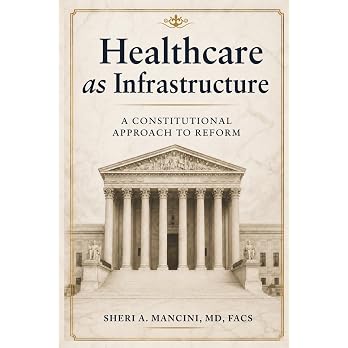
Healthcare as Infrastructure
What if we governed healthcare like roads, power grids, and water systems—not as ordinary commerce, but as essential infrastructure? Dr. Sheri A. Mancini examines the constitutional principles, institutional design, and governance structures that shape American healthcare, inviting readers to rethink accountability, stewardship, and public trust.
Explore the book on Amazon ↗Source: The Commonwealth Fund, Mirror, Mirror 2024 ↗ Netherlands government: Standard health insurance ↗ Swiss Federal Office of Public Health ↗